The Price Of Paradise
Rich Hippies Nederland Colorado 1973
Full Table of Contents: Surfing the Interstates: Complete Chapter Guide
Chapter Four: The Price of Paradise
The VW bus smells like patchouli oil and wet dog. But this isn't any road-worn hippie wagon.
'73 Westfalia. The deluxe camper model. Pristine orange and white paint job. No rust. Chrome gleaming like it just rolled off the Emden factory floor.
Know this world from the edges. The scholarship kids at Exeter lived next to it, never in it. My parents could afford the tuition, barely. These girls' parents bought the buildings.
The three women. Names like Susan, Jennifer, Patricia. Call themselves Star, Moon, and Molly. Peasant blouses from Bendel's. Turquoise jewelry from Santa Fe galleries.
Star's neck—that particular angle only serious money teaches. Watching her, I see every Exeter dance. Every girl whose last name was on a dormitory.
"We're heading to Nederland," she says. Adjusts a silver bracelet. Real silver, not the Mexican stuff I wear. "Molly's cousin has a cabin up there."
Molly. Cheekbones like Renaissance marble. The kind of girl who floated past in Penn's library. Never saw me. Never needed to. Different species.
"You play?" Star asks. Eyes unfocused—good acid. Clean acid. Her dealer probably has a trust fund too.
"A little."
"Play something, man. Bless our journey."
Three days ago would've tried to impress them. Would've played something complex. Proving I belonged. But River taught me different. Keith showed me real. The Montreal guys around the fire—that was church. This is performance.
Pull out the Harmony Cremona. Give them what they expect. Simple. Safe. Anonymous.
"Nice," Moon says. "Peaceful vibe."
Molly passes around a leather flask. Brandy. Wave it off—"Thanks, just ate." They don't insist. Already losing interest.
Watch the bus disappear up canyon. Could've gone with them. Cousin's cabin. Another place to feel like the guest who doesn't quite fit. Had enough of that at school.
The road taught me something. Real connection doesn't check your portfolio. Doesn't care what your father does. River with his flute. The mescaline circle. That's where music lives.
Not in Nederland. Not at any price.
Boulder spreads out below. Red tile roofs, mountain backdrop, picture-postcard perfect.
Walk down Broadway. Guitar case banging my leg. Already calculating. Three days on the road, money disappearing. Fear of running out always on my mind.
Old habit. Soon as I own something decent, have to know what it's worth. What I could get for it, in case I wake up broke.
Find a music store. Good instruments in the window. The Harmony Cremona came from Manny's on 42nd Street. Paid eighty-five for it. But that was then. Need to know what it's worth now. Need to know my options.
"Can I help you?" Guy behind the counter has that look—musician who's settled for selling instruments. Probably plays Tulagi's weekends. Tells himself it's temporary.
"Just wondering what this is worth." Pull out the Harmony Cremona.
Already know it's decent. Manny's doesn't sell junk. But knowing and confirming are different things. Like checking your bank balance. Necessary ritual of the almost-broke.
He examines it like a doctor. Tapping the top. Peering inside. Checking the neck. "Interesting. This is old—1920s, maybe '30s. Carved top, not pressed. The action is high, but the tone is there."
"What's it worth?"
"To the right buyer? Maybe two hundred."
More than double what I paid. Relief floods in. Then the familiar shame. Here I am, holding something beautiful, already calculating when I'll have to let it go.
"Course," he continues, "worth and value aren't the same thing. Would you take $95 for it?"
"No. Just curious."
Lie. Always planning to sell. Everything's temporary when you're one bad week from empty pockets.
He hands it back carefully. "Instrument like this, it's got songs in it. Just needs the right player to let them out."
Walk out. Two hundred dollars on my shoulder. If I had the time. The math of the marginally solvent. Always the math.
Outside, Boulder feels even more foreign. College kids heading to classes, local hippies who've found their niche, everyone belonging somewhere. The infamous "hill" where deals go down, might as well be Mars. Without connections, you're just another face.
Time to get higher. Literally. I never like cities. Get me to the forest.
Stand on the edge of town with my thumb out. Twenty minutes. Thirty. Then an old Chevy pickup pulls over. Guy inside looks like he's been assembled from leftover parts—thin where he should be thick, thick where he should be thin. Quiet sadness around his eyes.
"How far you going?" His voice barely above whisper.
"The park. Rocky Mountain."
"I can take you to Lyons."
Climb in. Little girl in the middle, maybe two, playing with a naked doll. She looks at me with that unnerving directness kids have.
"I'm Bill," the driver says. "This is Amy."
"Andre. Thanks for the ride."
We drive in near silence for a few miles. Amy humming to her doll. Bill chain-smoking Camels. Finally: "You been on the road long?"
"Few days. Coming from New York."
"I did that run. Other direction though. Canada to here." He flicks ash out the window. "Took two years off my life."
"Bad trip?"
"Federal prison." Says it flat, like stating the weather. "Draft thing. I'm Canadian, but they got me anyway. Two years in Leavenworth."
The truck suddenly feels smaller. Here is what my father wanted for me—military service or consequences. And here is the consequence, driving a beat pickup with his little girl, probably can't get decent work with a record.
"That's rough, man."
He shrugs. "Could've been worse. Some guys died in Nam. Some guys died in prison. I just did my time." Glances at my hair. "You serve?"
"Number 200. They took up to 160."
"Lucky." No judgment in it. Just fact. "I wasn't even in the lottery. Canadian. But I was here, working. They said that made me eligible." Bitter laugh. "Eligible for what?"
Amy starts fussing. He hands her a bottle one-handed, practiced. "Her mom split last month. Couldn't handle the life. Can't blame her. Hard being married to an ex-con who races motorcycles for grocery money."
"You race?"
"When I can. Broke more bones than I can count. Doc says I've had at least a thousand accidents, counting the small ones." He says it with weird pride. "But I'm still here."
We're climbing now, mountains getting closer. The gray sky matches Bill's truck, his mood, the weight of his story.
"Word of advice," he says as Lyons appears. "You heading through Wyoming?"
"Planning to."
"Avoid Cheyenne and Laramie. Real redneck. They see hair like yours, it's automatic—bust for vagrancy, disturbing the peace, whatever they can think of. Cost you money you don't have, time you can't spare."
"Thanks for the heads up."
"We look out for each other." He pulls over at a general store. "This is me. Need supplies."
Watch him get Amy out of the truck, her arms around his neck, him moving careful like his body hurts. The thousand accidents showing. A man who stood on principle and paid for it, while I'd been ready to run to Canada with my college deferment and family money.
"Take care, Andre."
"You too, Bill."
Standing outside the Lyons general store. Mountain town, one main street, tourism and timber. Two guys about my age sitting on their packs by the road. East Coast written all over them—that particular combination of prep school and dropout.
"You heading to the park?" The taller one asks. Boston accent.
"Yeah."
"Us too. I'm Brian. This is Dennis."
Dennis looks up from the book he's reading. Philosophy paperback. "From Philly," he says, like it explains everything.
"New York. Andre."
"Well, shit," Brian laughs. "The Eastern establishment, together again."
We don't wait long. Older guy in a Buick station wagon, plenty of room. Turns out he owns a motel in Estes Park, lives in Nebraska, works two days a week at Denver General with psychiatric patients.
"The crazy house," he says cheerfully. "Though honestly, after you work there a while, you start wondering who's really crazy."
The conversation flows—music, drugs, the nature of consciousness. The guy's son is a musician, out on the road somewhere. "Haven't heard from him in months. That's how I know he's doing fine."
"You're not worried?" Dennis asks.
"Worry doesn't change anything. Either he's okay or he's not. Either way, it's his journey."
The rain starts as we climb toward Estes Park. Fat drops, then sheets. The Buick's wipers struggling. By the time we reach town, it's a full downpour.
"You boys got rain gear?"
We look at each other. Of course we don't.
He pulls up to a camping store. "Get ponchos at least. Mountains don't play around."
Inside, staring at the prices. Even here, capitalism follows you up the mountain. Cheapest poncho is $3.50. But Brian finds a deal on bread, cheddar, and salami. Dennis grabs a bottle of wine. I contribute my remaining cash for our site fee.
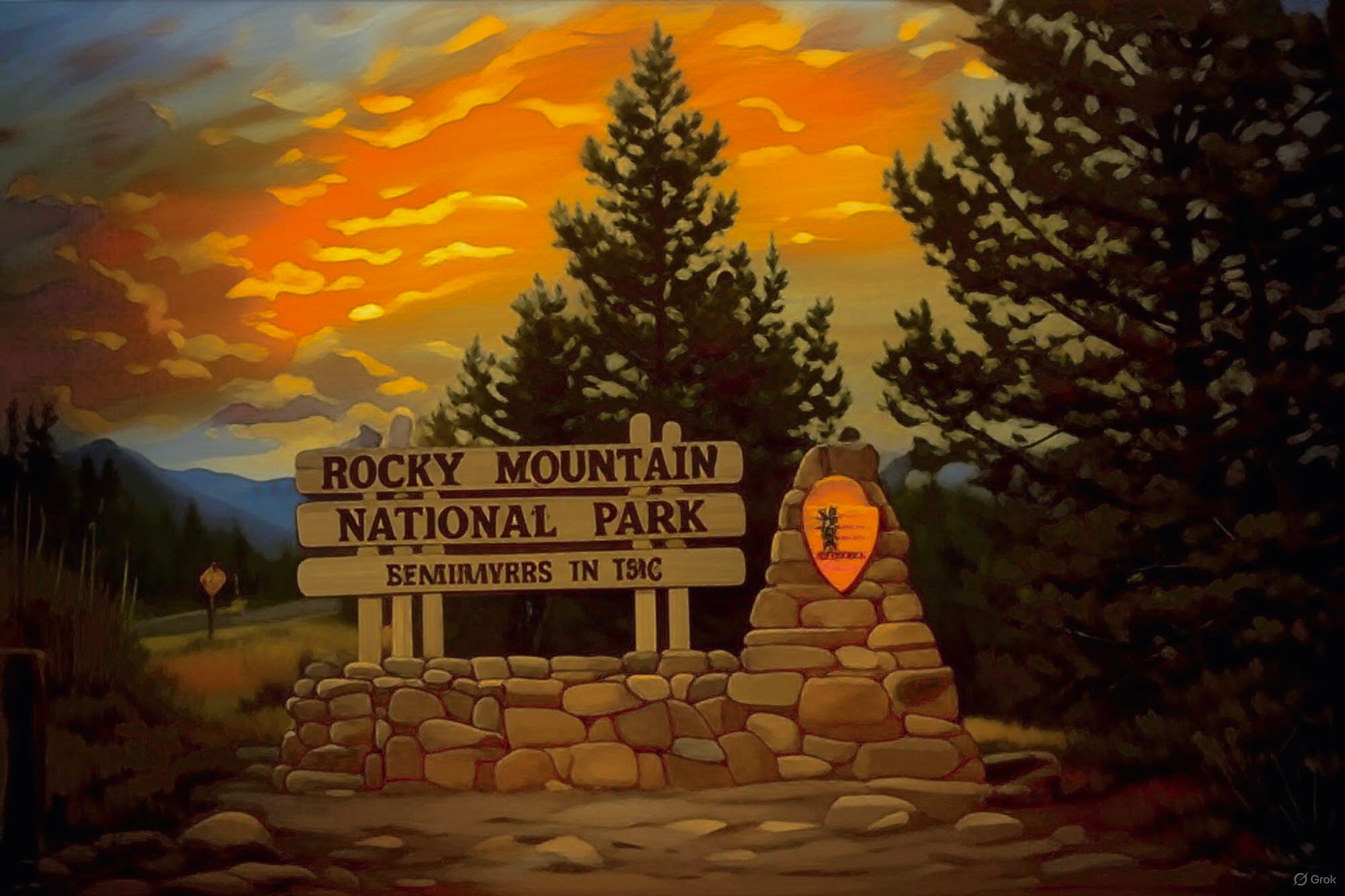
The park entrance is another shock. $0.50 just to walk in. $2 per car. $2 per campsite. $2 for firewood. Signs everywhere: $25 fine for gathering dead wood. $25 fine for camping outside designated areas. $25 fine for feeding wildlife.
"So much for the freedom of the hills," Brian mutters.
Find a site at Aspen Glen as darkness falls. Rain hammering down. Tent goes up crooked, already soaking through. Everything wet—sleeping bags, packs, spirits. But once we're inside, cramped but sheltered, something shifts.
Dennis produces his cassette player. Europe '72, just like mine. The Dead in the Rockies while we're in the Rockies. Brian slices the bread with his Swiss Army knife, rationing out cheese and salami like communion. The wine passes hand to hand.
"You know what this is?" Dennis says, philosophical even in a leaking tent. "This is exactly where we're supposed to be."
"In a flooding tent eating welfare sandwiches?" Brian laughs.
"No, man. Here. Now. Three guys who didn't know each other this morning, sharing food in a storm. That's the whole thing. That's what it's about."
The Dead play on. The rain hammers. We eat slowly, making it last. Outside, I can hear rangers making rounds, checking permits, enforcing paradise.
But inside the tent, we've made our own country. No permits required. No fees or fines. Just three refugees from the East Coast, wondering what we're looking for and knowing, somehow, that this is part of it. The seeking itself. The temporary families. The overpriced ponchos and the cheap wine and the way the Dead sounds different at altitude, fuller, like the thin air makes more room for the music.
Morning comes gray and cold. Everything damp. Brian and Dennis are heading deeper into the park. I'm thinking about that cabin in Glen Haven someone mentioned in Boulder. Up higher. Further from rules and rangers and the American tendency to package everything, even wilderness.
"You could come with us," Brian offers. But I can see they're budgeting every dollar, counting days against funds.
"Nah, I'm good. Think I'll head higher."
We split the remaining food. Addresses exchanged, though we all know we'll never write. The road doesn't work that way. You meet, you share, you part. The gift is in the moment, not the maintenance.
Stand by the park road, thumb out again. Watching families in station wagons heading to designated viewpoints. VW Westfalia Campers and Winnebagos. The wilderness made safe for democracy.
But somewhere up there, past the campgrounds and gift shops, the real mountains wait. The ones that don't care about your permits or your poncho or your carved-top guitar. The ones that just are.
The rain has stopped but the clouds hang low, hiding the peaks. Perfect. I'm not ready for clarity anyway. Just want to get higher, get quieter, get to wherever this road is really taking me.
A pickup slows. Construction workers heading to a job above Estes. They'll take me as far as Glen Haven.
"Know anybody up there?" the driver asks.
"Not yet."
He laughs. "That's the spirit."
Climb in back with the tools and lumber. The road curves up into clouds. Leave it to chance. Trust the road. Let the mountain decide.
$20 spent so far. $60 left. 7,500 feet and climbing. Still have the guitar the music store guy said has songs in it. Still have most of the weed. Still have miles to go.
But first, Glen Haven. Whatever that turns out to be.
→ Next Chapter: The Frequency of Freedom - Musical community and sound healing in Glen Haven
← Previous: Chapter Three - The Kindness of Strangers
Full Table of Contents: Surfing the Interstates: Complete Chapter Guide
💰 Have you ever experienced the tension between authentic counterculture and commercialized rebellion? Share your thoughts on who gets to "drop out."
This is Chapter 4 of 16 in my complete 1973 hitchhiking memoir.


