The Kindness Of Strangers
Music, Road Angels, and Finding Community While Hitchhiking (1973 Memoir)
Full Table of Contents: Surfing the Interstates: Complete Chapter Guide
Chapter Three: The Kindness Of Strangers
Wake to semis thundering past. Pennsylvania morning, already sticky. My back aches from the ground, throat raw from the Colombian. Everything damp with dew—sleeping bag, tent, even the inside of my guitar case.
Pack up quick. No grace in it, just efficiency. Stuffing wet nylon, rolling bags, checking I haven't left anything. The cassette player safe in the pack, that Dead tape like a talisman now. Evidence that all of it—Sara, the tambourine, Pigpen's knowing grin—actually happened.
Make my way back to the highway. Eight AM, thumb out, watching for cops.
A yellow VW Bug putters to a stop fifty yards up. Have to run for it, pack bouncing, guitar case banging my leg. The driver leans across, pushes open the passenger door. Skinny guy, maybe twenty-five, shoulder-length brown hair waving like mine. Faded work shirt, cutoff jeans, that easy smile of someone who's been on the road himself.
"Where you headed, brother?"
"California eventually. Anywhere west."
"I can take you to Hazleton. Hop in."
Wedge my pack in the tiny back seat, guitar case between my knees. The car smells like sandalwood incense and pot. Eagle feathers hanging from the rearview. McGovern sticker peeling off the dash, peace sign painted on the glove box. This is my tribe.
"I'm River," he says, grinding into first.
"Andre."
"Beautiful morning for it." He merges onto I-80, the little engine straining. "That your ax?"
"Yeah. You play?"
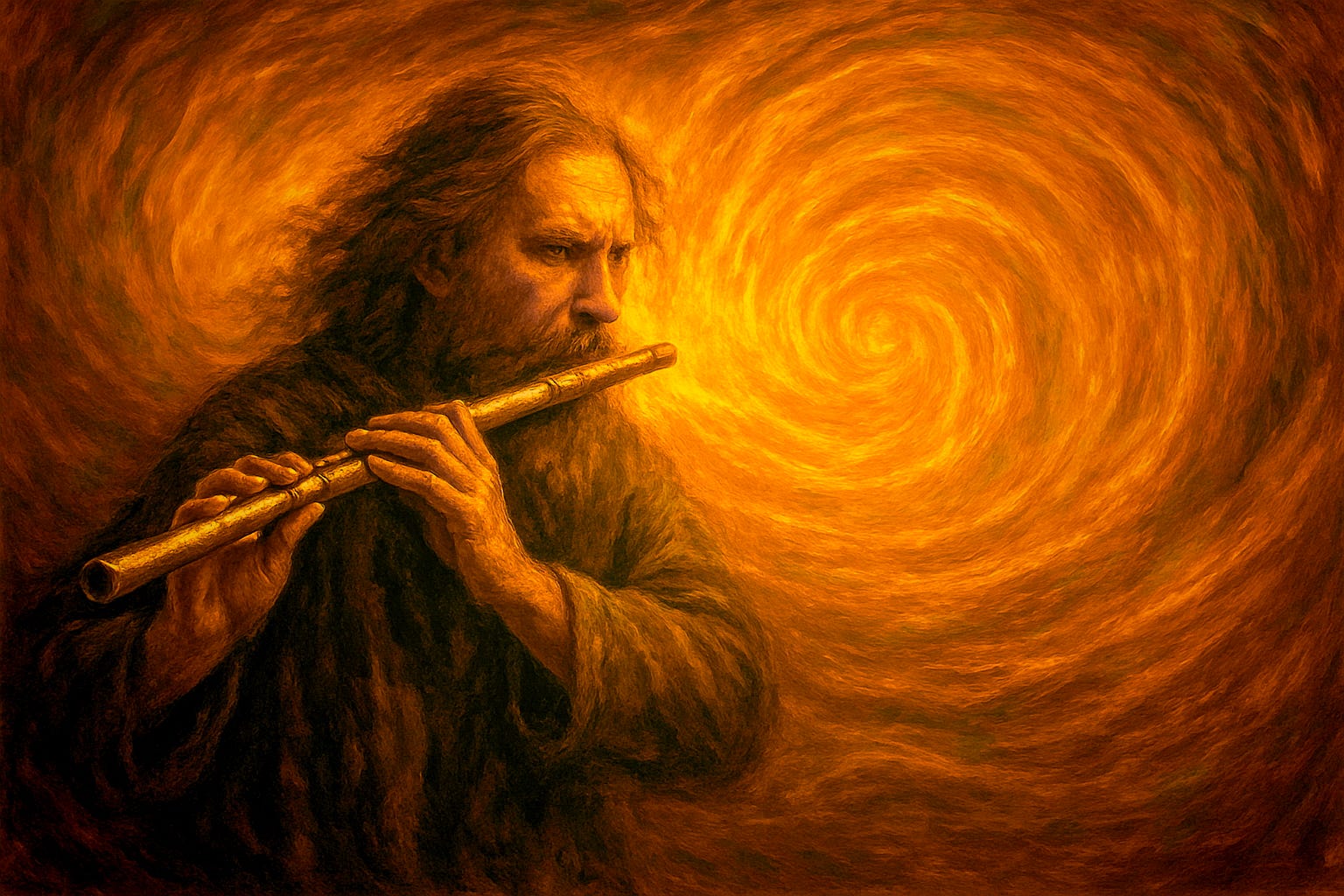
His whole face changes. "Flute, man. Been playing since high school, but Ian Anderson changed everything for me." He glances at my guitar case. "What kind of music you into?"
"Dead, mostly. Neil Young. Trying to learn some Garcia leads."
"Garcia's a genius. You know he started on banjo?"
"No shit?"
"Five-string. That's where he gets those rolling patterns. Like—" He drums his fingers on the steering wheel, demonstrating. "See? That's not guitar thinking. That's banjo thinking translated to guitar."
We talk music—the way only musicians can, diving deep into minutiae that would bore anyone else. He's seen Tull three times, describes Anderson's stage presence like a religious experience. "First time was '71, Aqualung tour. Anderson comes out, standing on one leg like a fucking flamingo, hair wild, eyes crazy, and just wails. I went home that night and threw away all my sheet music. Realized I'd been playing notes instead of music."
"What's the difference?"
"Notes are what's written. Music is what happens between the notes. In the silence. In the breath."
Tell him about my attempts to write songs, how they always come out the same. How I prefer playing melody lines behind someone else, adding texture but never being the focus.
"That's because you're thinking too hard," River says. "Music isn't in your head. It's..." He takes one hand off the wheel, touches his chest. "Here. And here." Touches his stomach. "The breath, man. Everything comes from the breath. You hold your breath when you play?"
Think about it. "Yeah, probably."
"That's fear. Fear of being heard. Fear of taking up space." He downshifts for a hill, the VW protesting. "Where you from?"
"New York. Westchester."
"Parents still together?"
"Just divorced."
"That why you're heading west?"
"Part of it."
Flash—twenty-first birthday, two months ago. Phone rings. My father's voice like a legal notice: "Andre, today you have reached your majority. One day you will look back at all the decisions you make and realize they have defined your life." Click. No "happy birthday." Just what he'd call "a swift kick in the ass"—his favorite cure for everything.
River nods, doesn't push. We drive in comfortable silence for a few miles, watching Pennsylvania roll by.
"My old man wanted me to be an engineer," River says eventually. "Had it all planned out. Penn State, good job, house in the suburbs. When I told him I was dropping out to play music, he didn't speak to me for a year."
"He come around?"
"Died before he could. Heart attack at fifty-two." He says it matter-of-fact, but his hands tighten on the wheel. "Last thing he said to me was 'You're wasting your life.' Maybe I am. But at least it's my life to waste."
The highway stretches ahead, heat shimmers already rising.
"Hey," River says suddenly, brightening. "Grab my flute from the back. Black case."
Find it wedged behind his seat, under a Mexican blanket and some paperbacks. Beautiful silver flute, intricate keys, obviously well-loved.
"Take it out, hand it to me."
"While you're driving?"
That grin again. "Trust me. You need to see this."
Hand him the flute. He positions it crosswise to his lips, takes a deep breath, then drops both hands from the wheel. The VW holds steady as he steers with his knees. Then he begins to play.
It starts like something medieval—a wandering melody that could've come from a castle tower. Then he bends the notes, adds flutter tonguing, turns it into something wild and electric. Like Jethro Tull meets Traffic meets something entirely his own. The flute crying and laughing, whispering and screaming, all while this maniac steers a Volkswagen with his knees down I-80.
His fingers dance over the keys while his knees make tiny adjustments to keep us centered in the lane. Sometimes he holds a single note, letting it build and waver, then cascade into a waterfall of runs. Other times he plays these staccato bursts that sound like bird calls from another planet.
I sit frozen, terrified and amazed. The music fills the small car, spills out the windows into the Pennsylvania morning. A semi passes us, horn blaring—whether in anger or appreciation, I can't tell. River just incorporates it into the music, matching the horn's pitch, turning it into a duet. Other drivers slow to stare. A woman in a station wagon full of kids applauds. A guy in a Corvette gives us the finger.
River plays on, eyes half-closed, completely absorbed. His knees never waver, keeping us true while his soul pours out through that silver tube.
Ten minutes. Fifteen. Time suspended while this beautiful lunatic creates art at sixty-five miles per hour. Pennsylvania becomes Tibet, becomes Mars, becomes the inside of a seashell. Finally he lowers the flute, grabs the wheel, laughing like a kid who's just done something gloriously stupid and gotten away with it.
"You see? That's what I mean about breathing. You can't think your way into that. You just have to trust."
"That was... insane."
"That was freedom, brother. That was saying yes to the universe and having the universe say yes back."
We ride in charged silence for a while, the ghost of his music still hanging in the air. My hands are shaking—from fear, from exhilaration, from recognition of something I want but don't know how to reach.
"You know what your problem is?" River says eventually. "You're scared of being seen. Playing lead, playing backup—it's all about hiding behind technique. But music needs vulnerability. It needs you to stand naked in front of people and say 'This is who I am.'"
Direct hit. Six years old, my father's study. First lesson on telling time. Wristwatch face blurring. "What time is it?" Each wrong answer making his voice sharper. My face burning red—always burning red. The slap. "Think!" But thinking only made me float away, somewhere safe. Learning early: the safest place was somewhere behind my own eyes.
"I had this friend," River continues, "guitarist like you. Incredible player, could cop any lick, sound like anyone. But he never sounded like himself. You know why? Because he didn't think 'himself' was enough. Thought he needed to be Clapton or Hendrix or Garcia. But the world already has those guys. What it needs is you."
"You don't even know me."
"I know you took the money from that tin box." He glances over, sees my shock. "Relax, man. We all do what we gotta do. But you took it gentle, like you were borrowing from your mom. That tells me something. Tells me you're not running from them—you're running to something. Just don't know what yet."
"How did you—"
"Same way I know your old man's got money but you don't. Same way I know you've been to good schools but they didn't take. Same way I know you've got French blood." He taps his temple. "It's all in how you carry yourself. Trying to take up less space than you deserve. That's inherited shame, brother. Probably goes back generations."
"My father's family was once 12th in line to the throne, actually."
River bursts out laughing. "No shit? Like Count Whatsisface?"
"His father was a count, yeah. And my father acts like one. We call him 'Dux'—Latin for military commander of a remote district. Fits him perfectly. Twenty-five acres at the end of a dirt road, no neighbors. His own little empire to rule."
"Let me guess," he continues. "Your old man wanted you to be a lawyer. Or a banker. Something respectable."
"For sure, but I won the Ralph Bradley Prize for film, fall of my senior year."
"No shit? That's heavy."
"Yeah. So Exeter let me take the whole spring semester senior year to make a real film. Forty-five minutes, 16mm, black and white. About how drugs and music were changing everything on campus."
River whistles low. "That's real art, man. Not some student bullshit."
"Hardest I've ever worked. When it was done, I applied to film school—NYU, UCLA, USC."
"And Dux said no."
"Wouldn't even let me mail the applications. He said, 'The film industry is controlled by Jews and Italians' and that I should study philosophy at the best Ivy League school I could get into."
"Fuck." River's hands tighten on the wheel. "He killed your dream."
"That was it. The thing that broke us. He couldn't see I'd found my calling."
"So instead he wanted—what?"
"West Point. Said I was destined for Vietnam anyway, might as well go as an officer."
River shakes his head. "My parents just wanted me to make money. Yours wanted you to be worthy of five hundred years of dead heroes. That's a whole different weight to carry."
The exit for Hazleton coming up. He puts on his blinker.
"Can I tell you something?" River says as he takes the ramp. "Something I learned the hard way?"
"Sure."
"When it comes to playing that guitar of yours, you can't play it for your father. Can't play it for your ancestors or your teachers or some girl you're trying to impress. You can't even play it for yourself, really. You gotta play it for the music. Let the music use you. Like—" He thinks for a moment. "Like the highway was using my knees back there. I wasn't driving. I was just the thing the road was moving through."
Pulls into a Sunoco station. Turns off the engine. The sudden silence feels huge.
"This is where we part ways, Andre of the noble blood." He reaches into the glove box, pulls out a joint wrapped in yellow paper. "For the road. And remember—music isn't about perfection. It's about truth. Your truth, whatever that is."
"Thanks, man. For the ride. For..." Gesture helplessly at the flute, the highway, all of it.
"Thank the road, brother. We're all just vehicles."
Get out, grab my stuff. Through the back window, see his flute case surrounded by books—Siddhartha, Be Here Now, Gurdjieff. The required reading of every seeker in 1973.
"Hey," he calls as I'm walking away. "What's the French word for freedom?"
"Liberté."
"Liberté!" He shouts it like a battle cry, starts the engine. "Find yours, brother. Whatever it looks like. Film, music, maybe both!"
Watch the yellow Bug merge back onto the highway, River's hair whipping in the wind. Still feel the ghost of that flute music, the impossible beauty of it. The pure trust of letting go of the wheel and playing anyway.
Five minutes at the Hazleton ramp. Ten. The sun climbing higher, promise of another scorcher. Semis blasting past, hot wind in their wake. Then a beat-up Dodge van pulls over. Massachusetts plates. Guy about my age leans out.
"Where to, man?"
"California."
"No shit? I'm going to Chicago. That help?"
"Perfect."
"Cool. I'm Keith."
Climb in. Instant immersion in road culture. Cracked windshield, Mexican blanket over ripped seats, smell of weed and Marlboros. Eight-track player mounted under the dash. Allman Brothers' "Ramblin' Man" coming through speakers that sound surprisingly good.
"Been on the road long?" he asks, pulling back onto I-80.
"Just started yesterday. Coming from New York."
"I been going two weeks. Down to Florida, across to New Orleans, now up to Chicago." He slots in a new eight-track. Neil Young's "Harvest." "Trying to catch my lady. She goes to Wellesley but she's visiting friends at Northwestern for the summer."
We pass a brass pipe back and forth, getting comfortable. Good weed, not too strong.
"You know what's fucked up?" Keith says. "I just got out of the Army three months ago. Half the guys I served with, they're not coming back. Or they're coming back wrong. And for what?"
Don't know what to say. The war is this shadow over everything.
"But hey," Keith brightens, "I'm out, I'm alive, and I got wheels. That's more than a lot of cats can say." He reaches behind his seat, pulls out foil-wrapped package. "You hungry? Lady in Baltimore made me banana bread."
We split it. Dense, sweet, still moist. Perfect road food.
"That your ax?"
"Yeah. Pre-war Harmony Cremona."
"Play me something."
That familiar tightness. "I mostly just noodle. Work out melody lines."
"Come on, man. We got miles to go. Keep me awake."
Reluctantly pull out the guitar. Tune it against the road noise, the Dead playing low in the background. Start picking out the melody to "Ripple"—safe, simple, nothing fancy.
"That's nice, man. Peaceful."
Keep playing, finding little variations, harmonizing with the album. Easier without eyes on me, just Keith watching the road, cigarette dangling, occasionally humming along.
"You know what I miss?" Keith says. "Playing with people. Had a band in high school. My girl, she'd come to all our practices. Sit on this broken amp, just smiling." His voice softens. "I'd play better when she was there. Not showing off, just... fuller, you know?"
"That's what I'm scared of," he continues. "Showing up in Chicago and she's different. College girl now. New friends, new ideas."
"You're driving a thousand miles to see her. That's not desperate, that's love."
"Maybe."
Outside Youngstown, spot them. Two guys by the on-ramp heading to Colorado for farm work. They pile in back, and within minutes we're all sharing stories. Keith has been quiet the last hour as Chicago gets closer.
"Hey man," one of them says. "You're gonna be fine. Girl knows you're coming, she wants to see you too."
Keith drops me at a cloverleaf outside Mendota as the sun is setting. The Colorado guys deciding to stop too.
"This is where I head north," Keith says. "You can probably camp in those trees."
We shake hands. Keith holds mine an extra beat.
"Thanks for the tunes, man. And for listening."
Watch him drive off toward Chicago, toward his girl, toward whatever is waiting.
Find a flat spot in the trees, hidden from the highway but close enough to hear the trucks. The Colorado guys have a routine down. Efficient camp setup.
Just as darkness falls, two figures emerge from the tree line.
"Salut! You guys camping here too?"
French accents. Montreal guys, maybe mid-twenties, huge grins.
"Plenty of room," someone says.
They introduce themselves—Jean-Pierre and Marc. Within minutes, they've produced a bottle of wine and gel caps filled with tan grit.
"Mescaline," Jean-Pierre explains. "Very gentle."
I pass, but the Colorado guys are game. Watch them swallow the caps with wine, toasting something in French.
"You play?" Marc asks, noticing my guitar.
"A little."
"Bon! I have this." Pulls out a harmonica. "We make music, yes?"
Start simple—twelve-bar blues, nothing fancy. Marc has that Montreal thing, blues with a French twist. I follow his lead, adding fills, building texture. Someone finds sticks, starts keeping time on a log.
Then the mescaline kicks in.
Marc's playing transforms. The harmonica becomes a voice, wailing these long notes that seem to contain entire stories. I try to follow but he's somewhere else now, pulling melodies from the air. So I just hold down the rhythm, give him a foundation to fly from.
This is what I've been looking for without knowing it. Not the spotlight but the circle. Not performance but participation. My guitar finally making sense as part of something larger.
I hand Jean-Pierre Pig's tambourine, adding polyrhythms that shouldn't work but do. The music spiraling out into the Illinois night, mixing with cricket songs and distant highway sounds.
Hours pass like minutes. At some point I realize I'm playing leads, actually soloing, but it doesn't feel like performing. Just conversation. Marc's harmonica asking questions, my guitar answering, everyone listening to everyone else.
Play until our fingers hurt, until Marc's lips are too sore to continue, until the wine is gone and the mescaline softened to afterglow. Then just sit in silence, watching the fire die to embers.
Wake early. Gray light, dew on everything. The Montreal guys already gone, left a note on my tent: "Keep on keeping on, mon ami. -J.P. & M."
The Colorado guys still passed out. Leave my own note: "Thanks for church."
Make it to the on-ramp. A series of quick rides—truckers, families, fellow travelers—blur together through the day. Each one adding a small piece to the puzzle. Stories of the road, warnings about cops in certain towns, recommendations for where to camp.
Denver at 1 AM. Dark city, mountains looming like walls. The last ride—a Ranchero with several people heading to Boulder—drops me at a highway junction.
"We're going up to Glacier Lake," someone says. "You should come."
Look at them—road family of the last few hours. Want so badly to say yes. But something holds me back. That old hesitation. That fear of overstaying, of imposing, of being one person too many.
"I'll catch up with you tomorrow maybe."
They shrug, understanding the strange mathematics of road decisions.
"Cool, man. If you change your mind, just ask around Boulder. Everyone knows the lake."
Watch the truck disappear into the darkness.
Find a spot off the road, unroll my bag on hard ground. Denver spread out below, lights like fallen stars. Alone again.
Why didn't I go with them? What is this thing in me that pulls back just when connection is offered? River called it: scared of being seen. But it's more than that. Scared of being disappointed. Scared of disappointing. Scared of wanting something too much.
Curl into my bag. Tomorrow I'll be braver. Tomorrow.
Morning in Boulder. University of Colorado student union, trying to feel human over eggs and coffee. Clean kids everywhere. Backpacks with textbooks instead of sleeping bags. Conversations about summer classes, internships, normal futures.
They look through me like I'm not there. My road clothes, my three-day smell, my guitar case marking me as other. Not their kind of freak. The acceptable kind—the kind who protest on weekends but show up for Econ on Monday.
Outside, Boulder spreads under cloudless sky. The Rockies like a wall to the west. California on the other side, but first these mountains to cross. First this loneliness to sit with. First this understanding that the road gives you exactly what you need—sometimes friends, sometimes solitude, sometimes the harsh clarity of a college town where you don't belong.
Finish my coffee. Gather my stuff. Time to find the highway again.
Thumb out. Guitar heavy. California still calling, still distant, still possible.
Maybe the point isn't to hold onto anything but to be grateful it happened at all. The music around the fire. Keith's nervous hope. River's flute defying physics and common sense.
All of it gifts. All of it church. All of it the underground teaching me how to be human, one ride at a time.
A VW bus slows, hazards flashing. Side door sliding open. Three women, big smiles.
"How far you going?" the driver calls out.
"Far as you'll take me."
"Hop in, brother. We got room."
Always room. Always another chance. Always the road, patient and endless, waiting to see who I'll become by the time I reach the other side.
I climb in, guitar first, ready for whatever comes next.
→ Next Chapter: Andre heads deeper into Colorado's mountains
← Previous: Chapter Two - Turn On Your Lovelight
Full Table of Contents: Surfing the Interstates: Complete Chapter Guide
🎸 Share your own road music memories in the comments
This is Chapter 3 of 16 in my complete 1973 hitchhiking memoir.