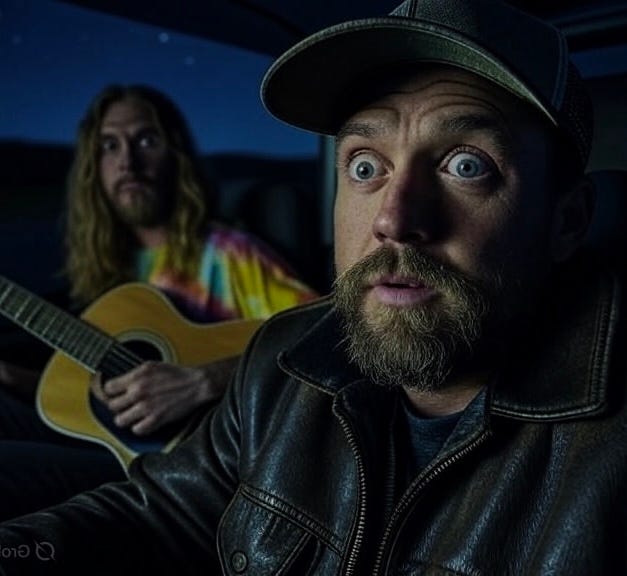
Solitary Push
Wyoming Wasteland & Friend's Paranoia 1973
Full Table of Contents: Surfing the Interstates: Complete Chapter Guide
Chapter Six: The Solitary Push
Leave Glen Haven in a Peterbilt hauling cattle to Cheyenne. Driver is all business—CB radio, thermos of coffee, no interest in conversation. Fine by me. Still processing the week on the mountain, the songs in my notebook, Lucy's stone in my pocket.
"Watch yourself in Wyoming," he says as we cross the state line. "Cops here don't take kindly to your type. Sixty days for vagrancy, no questions asked."
The landscape opens up like God has gotten tired of details. Just sage and sky and the occasional antelope. After Colorado's verticals, Wyoming feels like falling off the edge of the earth.
Get dropped at a truck stop outside Laramie. Wind that could strip paint. Stand there with my thumb out, watching semis blast past, thinking about Steve Ferry. Strange how the mind works—the emptier the landscape, the fuller the memories.
Met Steve freshman year at Penn. He was Wharton, I was Liberal Arts—different worlds that happened to share a dorm. First time we got high in his room, he was organizing his stash in film canisters, printing labels with a Dymo gun.
"Murder." "Insanity." "Death."
"Christ, Steve. Little dark?"
He grins. "Ever see 'Reefer Madness'? This propaganda film from the thirties. Claims pot makes you homicidal. 'Reefer Madness - The Deadly Scourge! Murder! Insanity! Death!' Total government bullshit. So that's what I call my stash. Ironic, right?"
But before that—before the paranoia, before the jokes turned real—he was just this brilliant kid from Jersey who could talk about Kerouac and derivatives with equal passion...
"They tried to scare us away from weed by saying it causes murder, insanity and death. But you know what really causes that? Fear. Fear of getting drafted. Fear of being watched. Fear of the system crushing you." He sealed the last canister. "I'm labeling these ironically now, but watch—in five years, everyone who refused to play their game will be labeled exactly this way. The paranoid ones. The crazy ones. The dangerous ones."
We bonded over music and weed and the particular alienation of being smart kids who wouldn't buy what they were selling. His father was some big shot at an advertising agency—sold America to itself for a living.
"Complete asshole," Steve told me once, passing the "Insanity" canister. "Beats my mother with words instead of fists. Drives her to the bottle then mocks her for drinking. Madison Avenue sociopath in a gray flannel suit." He took a long hit. "You know what advertising is? It's convincing people they're broken so you can sell them the fix. He's been doing it to her for twenty years."
No siblings. No buffer. Just Steve alone in that Jersey money prison. Last I'd heard, his mother had finally left, was living with her sister in Florida. Steve never mentioned her anymore—like she'd become another casualty of the war between him and his father.
Ride to Rock Springs. Mormon family who pick me up by mistake—think my guitar case is a violin, think I'm some conservatory kid. Too polite to kick me out when they realize their error. Eight hours of silence, kids staring at my hair like I'm a zoo exhibit.
Steve had this gift for finding music. Dragged me out to some hole-in-the-wall club outside Philly one night. "Trust me," he'd said. "Delaney and Bonnie, but I heard Clapton might sit in."
Always alone at these shows. Never brought the girl from the registrar's office he claimed to be seeing. Never brought anyone. Just stood there in the crowd, separate, watching Clapton like he was receiving instructions from another dimension.
Later found out the registrar's office girl was just someone he'd invented to seem normal—a character in his increasingly elaborate performance of sanity. "She understands me," he'd say, but she was no more real than the agents he'd later claim were watching him.
"You see?" he'd said after. "He walked away from Cream at the height of everything. Just said fuck it and started over. That's what I'm going to do."
Night in Rock Springs. Sleep behind a Denny's, using my guitar case as a pillow. Wake to a flashlight in my face—cop, hand on his gun.
"You got money?"
Show him my remaining forty dollars.
"Bus station's that way. Be on the first thing smoking or spend sixty days getting to know our jail."
Yes sir. No sir. Whatever you say, sir. The skills you learn as a long-hair in America.
Catch a ride at dawn with a speed freak heading to Salt Lake. Eyes like pinballs, talking about government satellites and mind control. Let him ramble, thinking about the night Steve told me about his draft physical.
The speed freak's rambling reminds me of Steve's late-night rants, the way his theories started making too much sense the later it got. The same jumping from connection to connection, the same certainty that everything was linked, everyone was watching.
"Number one," he'd said. "First fucking birthday they pulled. You believe that?"
We'd gotten spectacularly high. Seemed like the only rational response. But Steve was smart—smarter than me. Made an appointment with the campus shrink, played crazy just enough. Not overdoing it, just suggesting depths of instability that might emerge under pressure.
"Got my 4-F letter yesterday," he'd told me later. "Psychological deferment. Free and clear."
"What did you tell him?"
"The truth. That I'd rather die than kill. That I saw through everything they were selling. That made me crazy enough." He paused, something flickering behind his eyes. "Funny thing is, by the end of the session, I wasn't sure if I was playing anymore. Like I'd talked myself into actually being what I was pretending. Shrink kept asking about my 'violent ideation.' I kept saying I didn't have any. But the way he looked at me... like he saw something I didn't."
From Salt Lake to Reno. Trucker who's been driving for thirty-six hours straight, needs someone to keep him talking. Tell him about Glen Haven, about the songs, about heading to California to see a friend.
"California's a state of mind," he says. "Half the people heading there are running from something. Other half are running to something. Which are you?"
"Both maybe."
"That's honest at least."
Steve had dropped out after freshman year. Just walked away from Wharton, from his father's plans, from everything. His father cut him off completely—no money, no contact, nothing. "Dead to me," were apparently his exact words. Sent me a postcard from Santa Rosa: "Wine country is god's country, come check it out brother."
But I'd stayed another year, trying to make it work, pretending that the single class Penn offered in film was better than going to USC's Cinema School. Finally gave up after the Cambodia invasion, after they shut down the campus, after it became clear the whole thing was joke. Nothing there for me.
His last letter mentioned someone following him from the post office. "Same car three days running. Blue sedan. Two guys. They think I don't notice but I notice everything now." I'd thought it was the weed talking. Now I wonder.
Last summer, I was working my projectionist job at MCA when Steve showed up. Same wire-rim glasses, same compact energy, but something had changed. He'd been living the hippy dream and come back different. Relaxed on the surface but something coiled underneath. Like a spring wound too tight.
We walked to lunch and found a crowd starting to gather at 56th and Park. Pushed through to see—Jesus. Young woman splayed on the pavement like a broken doll. Blonde hair fanned out, one shoe missing, blood pooling from somewhere we couldn't see. She'd gone through the building's canopy from twelve stories up. The canvas had slowed her just enough to leave her face intact, beautiful and empty.
Steve stared at her for a long moment, studying her like she was a message meant for him. Then he turned away. "That's why I left New York," he said quietly. "The city eats people."
Then, softer, almost to himself: "Sometimes I think we're all falling. Just some of us haven't hit the ground yet."
"Steve—"
"She knew what she was doing. Took control. Chose her exit." He lit a cigarette with steady hands. "Most of us just wait for the ground to come up and meet us."
That afternoon, standing in that crowd of gawkers and grief, I'd decided. "I'm coming to California. You still at 5630 Old Redwood Highway in that chicken coop?"
"You're welcome any time." But his smile was off. Like he was already seeing how it would end. "Fair warning though—it's not what you think out there. The dream's got teeth."
Cross into California at night. Different air immediately—softer, scented with something I'll learn is eucalyptus. The driver, an old hippie running grow supplies to Humboldt, tells me I've missed the best years.
"Should've been here in '67. Before the dealers and the runaways. When it was still about the music and the vision."
But even diminished, California feels like possibility. Those golden hills in the moonlight, all looking like breasts and buttocks. The Sierras looming like promises or threats, depending on your state of mind.
Sonora at sunset. My last ride invites me to a barbecue at their place—ramshackle house on a hill, view of the whole valley. Cheap wine and good weed and guitars coming out as darkness falls. Playing those songs from Glen Haven, finding they translate to California just fine.
"Where you headed?" a girl asks.
"Santa Rosa. Friend has a place."
"Good town. Still real, you know? Not like the city."
Sleep on their floor, wake before dawn. Leave a note of thanks. Start walking toward Route 108 as first light hits the hills.
Thumb out. Ready to see what Steve has built from his great refusal. Ready to stop moving for a while. Ready to learn what California has to teach, if I'm ready to learn it.
The morning sun burns through the fog. Somewhere, someone is probably just sticking out their thumb for the first time, scared and thrilled and about to discover what I've discovered—that the road provides, but never what you expect.
And sometimes what it provides is a friend's paranoia made real, living in a chicken coop with a rifle and film canisters that stopped being ironic long ago. Sometimes the road leads you to watch someone hit the ground in slow motion, still convinced they're flying.
→ Next Chapter: Chicken Coop Days - Reunion with paranoid Steve in Santa Rosa
← Previous: The Frequency of Freedom - Musical community in Glen Haven
Full Table of Contents: Surfing the Interstates: Complete Chapter Guide
🤔 Have you watched a close friend change in ways that worried you? Share your thoughts on friendship and mental health.
This is Chapter 6 of 16 in my complete 1973 hitchhiking memoir.


