
Phantom Ships
Vision Quest in Big Bend Canyon After Fasting, 1973
Full Table of Contents: Surfing the Interstates: Complete Chapter Guide
Chapter Sixteen: Phantom Ships
Fifth day. Or maybe sixth. Time works different here. The limestone walls have become my monastery, the Rio Grande my only clock. Haven't eaten since El Paso. Maybe longer. The emptiness clean, necessary. Like the desert fathers. Like Jesus fasting forty days until the stones spoke.
First light finds me already awake. Or maybe I never sleep anymore. Just float between states like the hawk that lives in the high crevices. My body weightless, translucent. Could blow away on the morning thermals if not for the gravity of grief.
The canyon breathes with me. In. Out. These walls that were once ocean floor, that hold the fossils of creatures that swam where I sit. Time folded and refolded until past and future meet in this eternal now.
Pull out my Record. The pages feel like skin. The pencil heavy as bone. A golden poppy grows from limestone crack—impossible, insistent. Scorpion weed clusters near my bare feet, purple as bruises, purple as deep water. I write—
If when you read this, you feel tied down and unable to freely feel yourself, then hit the road and hitch to the woods—stand in a meadow listen to the rising and falling of the insect drone the chirp of grasshoppers and the buzz of golden green dragon flies hear the birds circle and call—get far enough away so you don't hear the drone of the interstate—peace is there in silence—peace is there right now as it always was and will always be—let this be an encouragement—I mean it as deeply as I can muster—go now a mile or 6000—it is everywhere—if only you be by yourself.
The words flow like the river below. No punctuation. No pause. One long breath of truth.
Set the pencil down. My hands are shaking. Or maybe it's the canyon walls, vibrating at some frequency only the fasted can hear. The sun crests the eastern rim and the limestone becomes flesh, glowing pink-gold, alive.
Stand. Bones creaking like old wood. Like the stairs in my parents' house. Like coffin lids. Everything is everything. The hawk cries and its voice is Steve's voice is my voice is the voice of the river that knows no names.
I see it then. The canyon itself as a living thing. Not a serpent but something older. The river its lifeblood. The walls its bones. Ancient beyond measure, holding the memory of seas, holding the patience of stone.
My tongue tastes copper. Blood or vision. Both maybe. The morning air shimmers like it did in the redwoods when Sasha's face became the moon became the Host became everything holy and broken.
Then—
Thunder that isn't thunder.
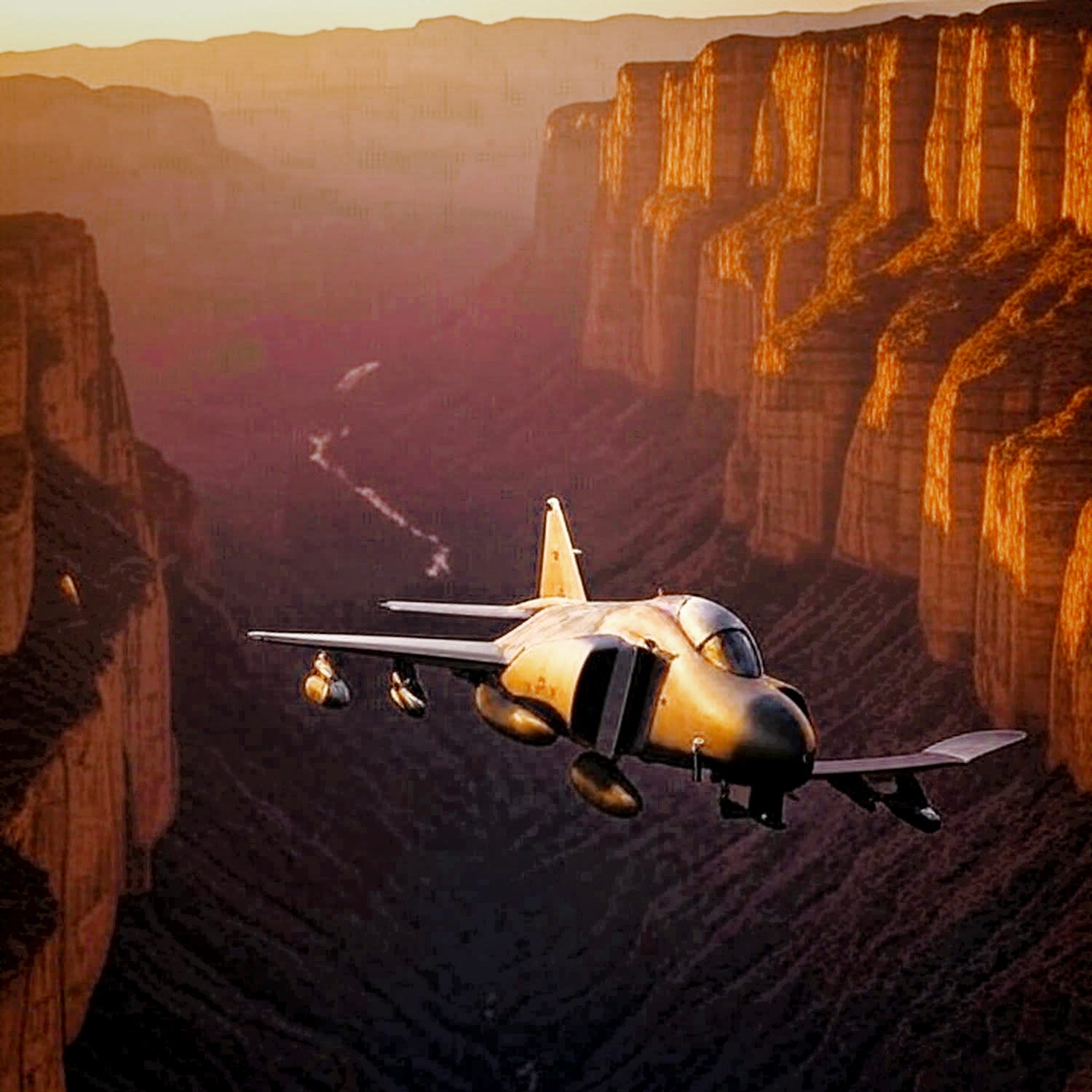
An F-4 Phantom screams through the canyon. So low I see both crew members—pilot and weapons officer in their tandem cockpits. The distinctive profile unmistakable—bent wings, drooping nose, twin engines trailing black smoke like the war itself made visible. They're using the canyon for low-level training, threading between walls at 500 miles per hour.
The sound trapped between stone walls, doubling, tripling. Not just engines but the shriek of air being violated. The Phantom—the same bird that dropped napalm on villages, that Steve watched on TV while perfecting his paranoia. Now here, practicing death runs in sacred space. The aluminum angel of war games, its camouflage paint job making it look like a flying bruise against the morning sky.
The rage comes up from the earth itself. Through my bare feet. Through my empty stomach. Through my chest until I'm screaming but no sound comes out because I've become the sound. Become the violation. Become the machine I hate.
"GET OUT!" But it's not my voice. It's Steve's. It's every dead boy's. It's the canyon itself rejecting this obscenity.
I grab stones. Ancient limestone fragments. Hurl them at the Phantom banking between the walls. But in the fasted light, in the clarity of emptiness, I watch them change. The stones leave my hand as weapons, as rage made solid. For a moment they carry all my fury—at the war, at Steve's death, at the machinery of violence.
Mid-flight, I feel their weight differently. This won't reach him. This won't change anything. The recognition hits like water. The stones seem to pause, hovering between rage and release. Then transformation begins—they sprout wings. Become doves. Become the birds the jet scared away. White against blue, rising on the same thermals the death machine rides.
Then the birds themselves dissolve. Become what they always were—prayers. Wordless prayers for Steve. For all the boys. For the pilot himself, trapped in his cockpit, playing war games over sacred ground.
And finally, inevitably, the prayers become what all prayers become when thrown against machines—nothing. Dissolving into desert air. Into the space between what we hope and what is. The Phantom untouched. The war continuing. My small human gesture absorbed by the enormous indifference.
The Phantom circles back. Lower. Those distinctive air intakes like hungry mouths. I can see the pilot's face through the canopy—young, focused, unaware he's flying through someone's church. The black smoke from the J79 engines writing cursive across blue sky. Someone's son playing war games where the river divides nations. The canyon walls seem to shudder. The ancient limestone rejecting this aluminum intrusion.
Then silence. Sudden. Complete. The kind that comes after lightning. After death. After the world ends.
I collapse. Knees on stone. The rage draining out through my palms pressed to ancient ocean floor. In the silence, I hear it. The hum. The same frequency from the redwoods. From the cemetery. From inside my own skull.
Dig through my pack with hands that belong to someone else. Someone who hasn't fasted. Someone who still believes in solid things. Find it. The Sony cassette player. Sacred technology. And the tape. And the joint. Last of the Colombian. Saved for the end of the world.
Light it with the last match. The smoke rises straight up. No wind in the canyon's throat. Hold it deep. Deeper. Until my lungs become the canyon become the sky.
Press play.
The first notes of "Wooden Ships" float up like souls. CSN harmonies bouncing between Texas and Mexico, between living and dead, between what is and what might be. The smoke making everything liquid. Stone flows. Water stands still. Time folds into origami birds that fly backwards into yesterday.
The song carries visions of escape. Ships with sails made of clouds. Decks made of songs. Crews of everyone who ever ran from war toward water. The canyon opens wider, becomes ocean, becomes possibility. Crosby, Stills and Nash singing of fair winds and distant shores, of leaving the foreign lands of violence behind, of finding somewhere far away where we might laugh again.
Another hit. The smoke thick as prophecy. Cross my legs into lotus. The position Sasha showed me that night in the redwood grove, after everything, when we were trying to find our bodies again. "Like this," she'd said, adjusting my knees, "so the earth can enter through your spine." Her hands patient as teachers. Her voice soft as futures I'll never have.
The stone beneath me soft as flesh now. Warm as her thigh when we moved through each other like water. Everything connected. Every moment containing every other moment. The redwood cathedral and this limestone canyon. The seeking then and the finding now. Or maybe still seeking. Always seeking.
The music enters my bloodstream. Becomes the thing my heart pumps. Steve is here now. Sitting across from me. Young. Before the fear got him. Rolling those film canisters between his palms like dice. Like bones. Like the future he already knew.
"It's all absurd," he says, and his mouth is full of ocean.
"I know," I tell him.
He looks at me. Really looks. The paranoia gone from his eyes. "You know what the funny thing is? I was right. They were watching. Just not who I thought. It was me. I was watching myself. Creating the thing I feared."
He sets down the canisters. They've changed. No longer labeled Murder, Insanity, Death. Now they read Past, Present, Future.
"You gotta get off the road, brother. It only goes in circles. Find something that moves different." He's fading now, becoming limestone, becoming river. "Find someone who moves like water. She'll know how to wash this clean."
His last smile. Not terrible anymore. Just sad and young and gone.
My father appears. Racing phantom horses across limestone. Breaking promises that echo in the canyon forever. Another kind of war. Another kind of death.
The joint burns my fingers. I let it. Pain is just another frequency. Another way of knowing you're alive. Like my elbow that never healed right—the growth plates damaged at six, infection eating at the bone while my father read "The Little Engine That Could" like willpower could fix what was already broken. Three weeks in the hospital learning that some things don't heal clean. They heal crooked. They heal into new shapes that work different.
The ash falls from my burnt fingers onto limestone. I watch it drift. Becoming nutrients. Becoming the poppy growing from stone. My crooked arm understands this. How you grow around damage, not through it. How the body finds new ways to move when the old ways are gone. All those years of my father trying to make me pitch like Juan Marichal, that high kick delivery, until I walked eleven batters straight and he finally gave up trying to fix what couldn't be fixed.
At Exeter, sorted into D2—the bottom of the bottom—because I couldn't do push-ups, couldn't climb ropes. My invisible disability teaching me early that the world has expectations your body might not meet. You adapt or you break. You find different ways to be strong.
The smoke rises. The pain clarifies. This burning nothing compared to bone pain, to growing wrong, to learning young that bodies betray you and life goes on anyway. The joint down to nothing now, just heat and plant matter becoming air. Everything impossible insisting itself into being. Everything broken becoming whole through breaking.
I see myself. All the versions. Multiplied like the jet's echo. The one who wanted to make films. The one who wanted to play guitar. The one lying in a canyon talking to ghosts. The one who will try to play it straight. The one who will fail. The one who will find boats and water and a different way to be.
The limestone walls are breathing with me now. In. Out. The whole canyon a lung. A throat. A birth canal. Something is being born. Something is dying. Maybe the same thing.
Then—another vision. Not memory but prophecy. Water stretching to the horizon. A boat's deck beneath bare feet. And her—not her face but her presence. Standing at the rail beside me. Her hair salt-tangled, her laugh mixing with gull cries. The one who'll know how to read the deep like those objects read the ocean. Who'll teach me that love has its own physics—not the broken geometry of the road but the circular currents of the sea. Always returning. Always deepening.
The canyon holds all of it. Stone and water and smoke becoming one thing. The stars watching. The river knowing. Everything connected in patterns too large to see but not too large to feel. The promise that everything dies and nothing ends. The song fading into the eternal silence that contains all songs.
The tape clicks off. The silence enormous as God. Fuller than any sound. I am empty. I am complete. I am located in the center of a universe that doesn't need me but includes me anyway.
Stand on legs made of water. Of light. Of five days' hunger and one joint's grace. Pack everything with hands that know what hands are for. Careful with the cassette player. That box of magnetic mercy.
One last look. The canyon indifferent and infinite. The ancient presence coiled back into stone, waiting for the next seeker. The river patient in its work of wearing down borders. Of making everything smooth. Of carrying what needs to be carried to the sea.
Start the climb. Each switchback a lifetime. Each step a choice between stone and water. The sun hammering down like truth. My shadow climbing beside me. Behind me. Becoming me.
At the rim, I turn. The canyon yawns like the mouth of everything. Like the womb of everything. Like the grave of everything.
But I'm already gone. Already walking toward highways and failures and futures that taste like salt. The seed planted. Not by the canyon. Not by the song. But by the emptiness that let them in.
Somewhere there are wooden ships. Somewhere Steve is learning to swim instead of drown. Somewhere we might laugh again.
Water is the answer. Not the roads I've been traveling but the ocean that waits. Patient as stone. Dark as the river between nations. Free as the space between heartbeats. Where the war can never follow. Where the laughter lives. Where I'm going.
And somewhere in that water world—I know this like I know my own name—she's waiting. Not the broken attempts at connection from the road. But someone who understands that love moves like tides. Patient. Inevitable. Returning always to the same shore. Someone who reads the deep currents. Who knows that some things can't be rushed, only discovered when the moon and water agree.
The thought carries me back into the world.
From above—if God watches—a figure emerges from the earth's wound. Tiny against the vast. Walking north through creosote and revelation.
The figure grows smaller. A mote of consciousness moving through the dream.
Higher still. The mote vanishes. The canyon remains. The river remains. The light remains.
Everything holy. Everything ordinary. Everything exactly as it is.
World without end.
Amen..
← Previous Chapter: Chapter 15: The Descending Dark - "Parting from Geoff and Jason, losing Jerry Garcia's blessed guitar to thieves in Big Bend"
📖 Full Table of Contents: Surfing the Interstates: Complete Chapter Guide
🎵 "Wooden Ships": CSN's anthem becomes the soundtrack to vision quest transformation - from war machines to sailing dreams, from linear roads to circular currents.


