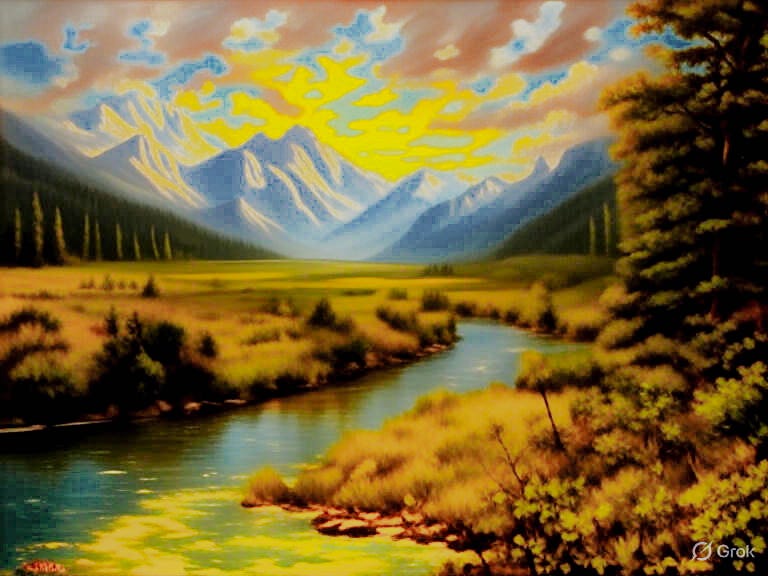
The Frequency of Freedom
Finding Musical Community in Glen Haven, Colorado (1973 Memoir)
Full Table of Contents: Surfing the Interstates: Complete Chapter Guide
Chapter Five: The Frequency of Freedom
Wake to rain. First drops, then steady percussion on the tent. Everything in Colorado seems vertical—even the weather falls straight down between canyon walls. Pack wet again. Story of this journey.
The ride from Boulder has been quick—construction worker in a pickup, doesn't want to talk, just drives. Drops me where Highway 7 meets Devils Gulch Road. Sign says Glen Haven, 3 miles.
Walking in rain. Guitar case slick, pack heavy with water. The road following a river—North Fork of the Big Thompson, though I don't know its name yet. Just know it sings louder than the rain.
Glen Haven isn't a town. More like a wide spot where the canyon briefly forgets to be narrow. One building that matters: Glen Haven General Store, dark wood and white trim, American flag hanging limp in the rain. Could be 1873 instead of 1973.
Under the covered porch, two figures with guitars. Long hair, backpacks, the uniform of the tribe. The taller one picking out a melody I recognize—"Do You Believe In Magic?" by John Sebastian. Sweet, simple, inviting.
"Nice changes," I say.
He looks up. Brown hair to his shoulders, face that smiles before his mouth does. "Thanks, man. You play?"
"A little."
"Well, come on out of the rain. I'm Steve. This is Mike."
Steve Burke from New Jersey. Will learn that later. Right then he's just the guy who makes space on the bench, who says "Let's see what you got" without making it a challenge.
Pull out Mona, my old Harmony. Tune it to his Martin while the rain drums overhead.
"Know any Dead?"
"Some."
"How about 'Know You Rider'?"
One of my faves. He starts singing, strong voice that doesn't show off, and I find the spaces between his rhythm, little runs and fills that comment without competing. Mike adds harmony. Simple as breathing. Right as rain.
Two girls materialize from the laundromat next door. The shorter one—blonde hair catching light even in the gray afternoon, eyes the color of Colorado sky when it isn't raining. Something in how she moves, like she hears music the rest of us can't.
Her companion is taller, dark-haired, with an earthiness that suggests she knows things—practical things, survival things. She studies us with hazel eyes that miss nothing.
"I'm Lucy," the blonde says. "This is Jade."
Jade steps forward, offers her hand. Firm shake, calluses that speak of real work. "You camping up the mountain?" she asks, direct.
"Trying to. This rain though."
"We know a spot," Lucy says, already swaying slightly to some internal rhythm. "Good tree cover, flat enough for tents."
"We were thinking the same. Safety in numbers?" Steve suggests.
Jade and Lucy exchange a quick look—some private communication. "Why not?" Jade says. "We've got a tarp, and I know where the good fishing holes are once this rain stops."
And that simple. No negotiations, no complications. Just the logic of the road—better to be wet together than wet alone.
Inside the store buying supplies. Canned beans, bread, peanut butter. The old guy behind the counter eyeing our hair but taking our money. Lucy buying dried fruit, dates and apricots, laughing at something Jade whispers. That laugh like little bells, like the tambourine I still carry but haven't told anyone about.
"You girls been up here long?" the counter guy asks.
"Few days," Jade answers. "Caught some nice rainbows up at the second crossing."
"Trail starts right outside," he says. "Steep as hell. Four miles to Piper Meadows if you're really ambitious."
"Just far enough to find a flat spot," Steve says.
"Creek's running high with this rain. Be careful."
Outside, shouldering packs. Five people who were strangers an hour ago, now heading up a mountain together. The trail is everything he warned—steep switchbacks through lodgepole pine, the smell of wet needles like incense, like the churches I've left behind but different. Cleaner. No guilt in this cathedral. And no fees. National Forest.
Jade takes the lead on the trail, moving with mountain confidence. "Watch that root," she calls back. "Slippery spot here." Lucy behind her, the two of them talking low, sharing some story that makes them both laugh.
Halfway up, the rain stops. Clouds parting like theater curtains to reveal the real show—peaks all around, some still holding snow in July. Twin Sisters, Long's Peak, the geometry of rock and sky that makes human problems seem temporary.
"There," Mike points. Small meadow beside the creek, ring of blackened stones from some previous fire. Flat enough for tents, far enough from the trail for privacy.
Setting up camp with practiced efficiency. Steve and Mike pitch their tent with the ease of old routine—makes me wonder how long they've been traveling together. The girls have their own rhythm too, Jade directing the placement while Lucy gathers stones for a better fire ring. "Not those," Jade says. "The flat ones. They hold heat better." Everyone knows their role without discussing it.
First night. Fire finally catching despite the damp. Jade has found dry kindling under a protective overhang, showing us her technique. "See? Always dry under here. The trees know how to shelter what's important." Passing a joint—good Colorado green, not the Colombian I've been saving. Everything softer through that lens, edges blurred but center sharper. Steve pulling out his Martin.
"Play that thing from the porch again," Lucy says.
"'Do You Believe In Magic'?"
She nods, already swaying. Steve starts, and I know all the words though I don't sing them. About a smile you can't wipe off your face. How the magic's in the music, and the music's in me. But Lucy dancing makes it profound—bare feet in mountain grass, spinning like the earth itself is her partner.
Mike watches her dance, then looks at Jade. Something passes between them—permission? Understanding? She stands, joins Lucy, the two of them moving like they've done this before. Like sisters. Like something else.
"They're beautiful together," Steve says quietly, watching them. "Sometimes I think we're all refugees. Running from different versions of the same bad dream."
"What's your bad dream?" I ask.
"The one where they tell you what success looks like and you believe them until you don't." He shifts chords, finds something minor. "My dad worked forty years for the phone company. Retired with a gold watch and a cough that won't quit. That's supposed to be winning?"
"My old man wanted me to be a senator or a cardinal or a colonel," I say. "I wanted to make films like Ingmar Bergman or Fellini. But I've moved on. I just wanna play guitar."
"Maybe we're the sane ones. Running toward something better."
The girls spin closer to the fire, and Jade whispers something that makes them both laugh—private joke, private language. Mike stands, joins them, and for a moment they're a three-bodied creature, moving to music only they can hear completely.
"You ever feel like you're watching life instead of living it?" I ask Steve.
"Every day, man. But sometimes—" He hits a chord that rings perfect in the mountain air. "Sometimes you get to do both."
Second day. Wake to Steve already up, practicing by the creek. Working out something intricate, fingers finding patterns I can't follow yet. Mike and the girls still in their tents—one tent, I notice now, though I saw them put up two the night before.
"Morning. Coffee?"
Has a little camp stove, efficient as everything else about him. Makes cowboy coffee while I wash my face in water so cold it feels like being reborn.
"Want to learn this?"
Shows me patiently. Not teaching exactly—more like revealing what's already there. "See, if you think of it as a conversation between the bass notes and the melody..."
Get it on the third try. The satisfaction of shapes fitting together, of understanding spreading from fingers to brain instead of the other way around.
"I knew this guy," Steve says after a while. "Played with everyone. Sessions in the city, you know? Making real money. But he said the best music he ever made was at a folk festival, three in the morning, bunch of nobodies playing for each other. Said that's when he understood what it was for."
"What was it for?"
"Connection. Not audience and performer. Just... connection."
Lucy emerges from the tent alone, hair wild, wearing Mike's shirt. Smiles at us—no shame, no explanation needed. "Morning, music makers. Save any coffee for the dancers?"
That becomes the rhythm of our days. Wake, coffee, music. Lucy disappears with Jade, comes back with handfuls of wild strawberries, tiny explosions of July sweetness. Sometimes Mike goes with them, sometimes not. The mathematics of their arrangement beyond my algebra, but it works, whatever it is.
"Jade knows every edible plant in these mountains," Lucy says one afternoon, building one of her stone sculptures by the water. "She's teaching me. Says it's about learning to see what's always been there."
"Like us," Jade adds, appearing with an armful of greens. "We're all orphans out here. Self-orphaned, maybe, but still."
"Speak for yourself," Mike says, but gently. "Some of us are just on vacation from the asylum."
"Same thing," Lucy insists. "We all walked away from something that wasn't working."
Jade sorts the greens with practiced hands. "Or couldn't stomach anymore. My family wanted me to marry this guy, settle down. Have kids. The whole program. I tried to want it." She shrugs. "Turns out you can't make yourself want something just because it's expected."
"My brother's in Vietnam," Mike says suddenly. "Real nightmare. Writes me letters about the smell of diesel and death. Says the worst part is how normal it starts to feel."
Steve finds a minor key, appropriate soundtrack for the conversation. I follow, letting the notes ask the questions I can't form.
"He coming back?" Lucy asks.
"Body is. Jury's out on the rest."
We play music to fill the silence that follows. Some truths too big for words, only notes can hold them.
Third night, or maybe fourth. Time getting slippery, not from drugs but from routine, from the eternal present of mountain life. After dinner—trout that Jade caught at dawn, cooked perfect over coals—Lucy pulls out a small flute from her pack.
"My teacher in Austin makes these," she says. "She's been showing me how sound can be medicine. Different frequencies for different healing."
She plays something that isn't quite melody, isn't quite rhythm. Notes that seem to hang in the air longer than they should. Steve picks up his guitar, finds notes that complement without competing. I join in, and for a while we're a single instrument played by the mountain itself.
"You ever notice," Lucy says during a quiet moment, the flute resting in her lap, "how music only exists in the breaking? Like, the silence has to break for sound to exist?"
"That's deep," Mike says, but not mockingly.
"No, listen. What if the break is the point? What if we're not supposed to return to quiet?"
"Like that Japanese thing. Where they fix pottery with gold."
"Kintsugi," Jade supplies. "Making the broken places stronger."
"Exactly!" Lucy's eyes huge in the firelight. "The cracks are where the light gets in."
They wander off together eventually—Mike, Jade, and Lucy—toward the creek, their voices mixing with water sounds. Steve and I keep playing, pretending not to notice the intertwined shadows they make against the stars.
"You understand what's happening here?" Steve asks quietly.
"Not really."
"Me neither. But it's beautiful, whatever it is."
Fourth day, definitely fourth. I've been keeping track in my notebook, along with the songs. Morning clear and sharp, the kind that makes you grateful for eyes. Find Lucy alone by the water, feet in the shallows, playing her flute so quietly it might be the wind.
"Hey," I say.
"Hey yourself. Sleep well?"
"Like the dead."
She laughs. "The dead don't sleep. They dream in frequencies we can't hear."
Sit beside her, not too close. The water so clear I can see individual pebbles on the bottom, each one placed just so by current and time.
"Can I ask you something?" she says.
"Sure."
"Why are you so careful?"
"What do you mean?"
"You're always watching. Always one step outside. Like you're afraid of breaking something."
Think about it. "Maybe I am."
"But everything's already broken, remember? That's what I was saying about the cracks. We're all just trying to make something beautiful from the pieces."
"And you?"
"I'm still listening." She looks at me directly, those impossible blue eyes. "What about you? What are you making?"
"I don't know. Nothing. Just moving."
"Movement's a kind of music. Every step has rhythm."
She stands, brushes sand from her jeans. "Come on. Let's find breakfast."
Leads me upstream, pointing out plants I've walked past without seeing. Miner's lettuce, wood sorrel, wild mint. Her hands quick and sure, building a salad from the mountain itself.
"Learned this in Texas," she says. "From the woman who's teaching me about sound healing. She says everything vibrates at its own frequency—plants, stones, people. Once you learn to hear it, you can help things find their natural harmony."
Back at camp, Steve teaching Mike something complicated, their heads bent together over the guitar neck. Close enough their hair tangles. Jade watching them with an expression I can't read—tender, amused, something else.
"Beautiful, aren't they?" Lucy says quietly.
"They've been together a while?"
"Define together." She starts preparing our wild salad, adding dried fruit from her stash. "They're friends who sometimes share more. Like all of us."
"All of us?"
That laugh again. "Oh, Andre. You really don't see it, do you? We're all in love out here. With the road, with the moment, with each other. The regular world's rules about who can love who, how many, what it means—we left those behind."
Feel young suddenly. Younger than twenty-one. Young as that seven-year-old altar boy who thought he understood ritual until the ritual exploded into something real.
"I don't think I know how to do that," I say.
"Do what?"
"Love like that. Without... walls."
She touches my hand. Brief, electric. "You're doing it right now. Playing music with strangers, sharing food, sharing stories. That's all love is. The rest is just bodies finding their own rhythm."
That night—fifth? Sixth? The notebook says sixth—we play everything we know. Steve has been writing down lyrics, with all the chords carefully placed above, in my Record during the quiet afternoons, his handwriting neat as his guitar playing. "I Shall Be Released." "The Wheel." "Mother Nature's Son." A curriculum for the counterculture.
"This one's about circles," he says, showing me the changes for "The Wheel." "Everything in folk music is. Verses that return, choruses that repeat. Like life."
"Or like death," Mike adds, philosophical from the evening's joint. "Same circle, different arc."
Lucy and Jade dance to everything—fast songs, slow songs, the spaces between songs. Sometimes together, sometimes with Mike between them, sometimes pulling me or Steve into their orbit. No jealousy, no possession. Just bodies celebrating their temporary alliance against the dark.
"You know what this is?" Lucy says during a water break. "This is what happens after. After the bombs or the flood or whatever ends it all. The ones who survive find each other and make this." She gestures at our circle, our fire, our temporary paradise. "We're practicing for the apocalypse."
"Cheerful," Steve says.
"No, really. Think about it. No money up here. No government. No rules except be kind, share what you have, make something beautiful. We're already living in the after."
"After what?" I ask.
"After the old world ended. Didn't you notice? It's gone, man. Vietnam killed it, or Nixon, or maybe it was always dying. We're just the first to stop pretending it's alive."
Jade looks up from braiding Lucy's hair. "That's why they hate us so much. The straight world. We're proof they don't have to live like they do."
Mike starts a Dead song, "Box of Rain," and we all join in with what we remember. The words fractured between us—Steve knows verses I don't, Lucy hums the bridges, Jade surprisingly clear on the whole last section.
"That's my favorite part," she says. "How it could be anything. Tragedy or decoration. Same box, different eyes."
Play until the fire dies, until the cold drives us tentward. But first, Lucy stands, formal suddenly.
"I want to say something. Before this ends."
"Who says it's ending?" Mike asks.
"Everything ends. That's what makes it precious." She looks at each of us. "You're my family this week. Whatever that means, whoever we are down there—" she gestures toward the invisible world below, "up here we're family. And I love you all."
"Love you too, Lucy in the Sky," Steve says, and means it.
Group hug. Five bodies trying to occupy the same space, laughing at the impossibility, achieving it anyway for just a moment. Then separate tents, separate dreams, but dreaming variations on the same theme.
Last morning comes gray, clouds low. Wake early, can't sleep. Find Lucy already at the creek, naked from the waist up, washing in the ice water. Turn to go but she sees me.
"It's okay," she says. "Just skin."
Stand frozen anyway. The morning light on her wet skin, the casual beauty of it. She wrings out her hair, smiles at my obvious discomfort.
"You can look, Andre. Looking's not a crime."
"Sorry, I—"
"Come here."
Walk over, trying not to stare, failing. She takes my hand, places it on her wet shoulder. Cold and warm at once.
"See? Just skin. Just a body." She moves my hand down to her ribs, lets it rest over her heartbeat. "Just a heart doing its job."
"Lucy—"
"I know what you want," she says quietly. "And it's sweet. But you want it to mean something it can't mean. Not for me."
"What do you mean?"
"You want it to be just us. Special. Separate." She covers my hand with hers, keeping it against her skin. "But I can't do special. I can only do real."
Feel young again. Young and foolish and transparent. "In Austin—"
"Maybe." She smiles, releases my hand. "If you make it to Austin, if the time is right, if the music says yes. But it won't be what you think. It'll be what it is."
"What will it be?"
She pulls her shirt on, the moment shifting back to ordinary. "I don't know. That's what makes it interesting."
Back at camp, everyone packing. The spell broken or completed. Steve and Mike efficient as always, their tent disappearing into stuff sacks. Jade watching me with knowing eyes—she's seen us at the creek, I can tell. No judgment, just acknowledgment.
"Where you heading?" I ask Lucy as we all prepare to descend.
"Austin first. Need to see my teacher, learn more about sound healing." She touches the leather pouch at her hip. "Then maybe California. Everything's maybe."
"I might come through Austin. When I head back east."
"Might's good. Maybe's better." She smiles. "I'll be at—" Gives me an address I'll remember. "Ask for the sound healer. They'll know."
Jade steps forward, shakes my hand. "Take care of yourself. And remember what Lucy told you about the cracks. That's where the light gets in."
The hike down easier but sadder. Steve and Mike talking about Utah, about people they know there. The girls comparing routes west. Me silent, trying to memorize everything—the way the trail curves, the sound of five voices bouncing off canyon walls, the weight of a week that feels like a lifetime, the ghost feeling of Lucy's heartbeat under my palm.
At the general store, exchanges. Steve gives me his New Jersey address. Mike writes down a place in Salt Lake where mail might reach him. Lucy presses something into my hand—a smooth stone from the creek.
"To remember," she says.
"Like I could forget."
"You'd be surprised what we forget. What we have to forget to keep moving."
Quick hugs all around. Lucy's lasts a beat longer, her lips by my ear: "If you make it to Austin, bring your guitar."
Then gone. Different cars, different directions. The arithmetic of the road—five becoming one in less time than it takes to tune a guitar.
Sit on the bench where it started. The old man in the store watching me through the window, probably glad to see the hippies dispersing. Pull out my notebook, look at the songs Steve has written out for me. Seventeen songs in seven days. A new vocabulary for whatever comes next.
But more than songs. In the margins, I've written fragments:
Everything good is temporary
The cracks are where the light gets in
We're all in love out here
Just skin, just a heart doing its job
Maybe's better than might
Try to play "Do You Believe In Magic" alone but it sounds hollow. Pack up the guitar. Time to move.
A pickup stops. Old rancher, probably horrified by my hair but too polite to say.
"Where to, son?"
"West. California."
"Can take you as far as Granby."
"That'd be great. Thanks."
Climbing in, guitar between my knees. The rancher has the radio on—country station, songs about losing and drinking and losing again. Different vocabulary but maybe the same language underneath. Everyone singing about the breaks and the light getting in.
"You one of them musicians?" he asks.
"Trying to be."
"Well." He considers this. "My daughter plays guitar. Says it saved her life after her husband came back from overseas. Different, you know?"
"Yeah. I know."
"Maybe that's what it's for. Music. Saving lives."
"Maybe so."
Watch Glen Haven disappear in the side mirror. Somewhere behind us, Lucy and Jade heading to Texas, to the sound healer, to frequencies only they can hear. Mike and Steve rolling toward Utah, toward their own configuration of love and road and song. All of us dispersed but still connected, like notes in a chord played across miles instead of frets.
In my pocket, Lucy's stone smooth and warm. Against my palm, the memory of her heartbeat, the promise and warning of Austin. In my notebook, seventeen songs and the memory of a week when I learned to stop watching life and start living it, even if I didn't quite learn to love without walls.
But I've touched those walls, felt how thin they are, how warm. Sometimes that's enough. Sometimes that's everything.
The road west unwinds like a song I'm still learning to play. No destination except forward. No plan except the next ride, the next temporary family, the next chance to practice for whatever comes after the old world finishes dying.
Box of rain will ease the pain. Love will see me through.
Or something will.
Same thing, maybe.
→ Next - Chapter Six: Solitary Push
← Previous - Chapter Four: The Price of Paradise
Full Table of Contents: Surfing the Interstates: Complete Chapter Guide
🎸 Have you discovered a place that felt like a musical sanctuary?
This is Chapter 5 of 16 in my complete 1973 hitchhiking memoir.


