
Chicken Coop Days
Surfing The Interstates: Chapter Seven
Full Table of Contents: Surfing the Interstates: Complete Chapter Guide
Chapter Seven: Chicken Coop Days
Rolling up to 5630 Old Redwood Highway in the back of a pickup. Late afternoon, July 25th. Driver found me thumbing on 101 with a cardboard sign: "Santa Rosa."
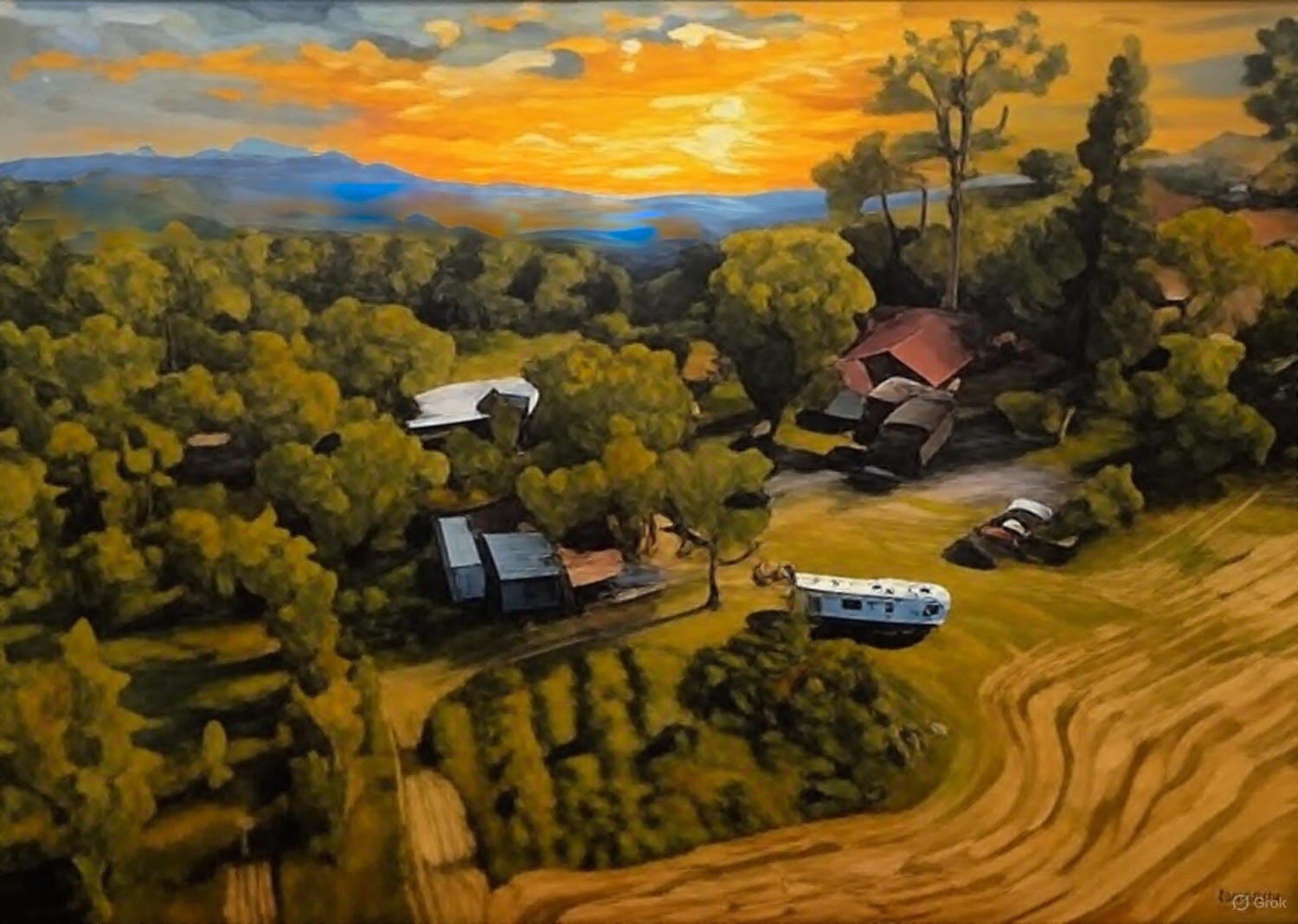
The place matches Steve's letters. Derelict prune ranch, twenty acres of neglected trees. Mission-style house needs paint. Ramshackle garage with an actual redwood beside it—not one of those Avenue of the Giants specimens but impressive enough. Maybe twelve feet at the base, hundred fifty feet tall. Top like lightning amputated it.
The sight stops me cold. That truncated top—it's Gary's arm. It's my elbow. It's every broken thing trying to grow despite the damage. Lightning has snapped the original crown clean off, leaving maybe three feet of charred stump. But the tree hasn't died. Instead, new growth has emerged from the side like a green thumb, growing sideways at first below the break, then turning skyward, adding another twenty-five feet. A tree that should reach three hundred feet, stopped at half that. Still alive, still reaching, but forever marked by whatever violence took its crown. Growing around the wound, not through it.
I know about truncation. Six years old, imitating the Little Rascals on TV, walking on a stool like they walked on telephone wires. The fall. The compound fracture. Three weeks in the hospital while infection ate at the growth plates. My father reading "The Little Engine That Could" like willpower could heal bone. Later, him trying to turn me into Juan Marichal, making me pitch over and over while cartilage ground against damaged bone, that high kick delivery he loved. Until the day I walked eleven batters straight and he finally gave up trying to fix what couldn't be fixed.
At Exeter, they tested all 112 of us. Four groups—A, B, C, D—each split in half. I landed in D2. The bottom of the bottom. Not because I was weak but because I couldn't do push-ups, couldn't climb ropes. My invisible disability sorting me with the other broken boys.
Steve's place sits 200 yards behind the main house. Converted chicken coop. Ten by ten if that. Ramshackle wooden garage next to it.
He comes out as the truck pulls away. Thinner than at Penn. Rolling a cigarette. Hair getting long, shirt wrinkled. Still has that James Dean jawline, that Brando scowl. But something's different. The energy maybe. That manic brilliance from college turned inward somehow.
"Brother," he says. Our old greeting from Philly.
"In the flesh."
We shake, quick embrace. He smells like tobacco and sweat and something new—whiskey. We're both damaged goods recognizing each other. Both trying to grow around what got broken early.
Six weeks ago, everything was different. June 10th, RFK Stadium. I'd hitchhiked down from New York, Steve from Jersey where he'd gone to "take care of some things"—probably selling off the last of his possessions, burning bridges with family. We'd met at dawn by the Washington Monument, already coming up on MDMA he'd scored from that chemist friend at Penn.
"This is the real medicine," he'd said, handing me the capsule. "Not like acid. No fear. Just... opening."
He was right. The MDMA was nothing like LSD. No confusion, no paranoid edges. Just this crystalline clarity. Love without agenda. We played frisbee among the early joggers and government workers, everything soft and possible. Even the cops smiled at us—two long-haired kids spinning a disc in the shadow of American power.
"You realize what's happening?" Steve had said, the Capitol dome glowing pink behind him. "The war's over. We won. We outlasted the bastards."
By the time we reached RFK, the heat was biblical. But inside that stadium, with the Dead's new Wall of Sound—sixty feet of speakers, bass notes that could literally bend you in half—something else was happening. Twenty thousand people moving as one organism despite the ghosts.
Because the ghosts were everywhere that day. Pigpen dead three months. Duane Allman gone since '71. Berry Oakley following him last November—motorcycle accident three blocks from where Duane died, like death had marked that spot in Macon and waited. The Allman Brothers playing as five instead of seven. The Dead without their blues preacher.
"Kent State was three years ago," Steve said during set break, both of us drenched in sweat. "They shot those kids for throwing rocks. Just like they wanted to shoot us for saying no."
But on the MDMA, even death felt different. Not an ending but a transformation. When the Dead played "He's Gone" for Pigpen, the whole stadium singing "Nothing left to do but smile, smile, smile," it felt like acceptance. Like we were all learning to carry our ghosts instead of being haunted by them.
During "Eyes of the World," as I was starting to connect with a spinning girl with flowers in her hair, Steve had grabbed my shoulders. "This is it, man. This is what we're fighting for. Not their wars. This. Being alive. Being together."
I'd never seen him happier. The paranoia that had been building since Penn completely dissolved. For one perfect day, he was just a kid at a concert with his friend, feeling the music, believing in the future.
Now here he is, six weeks later. Same Steve but hollowed out. Like something has drained the color from that perfect day.
Carefully setting down the beaten guitar case. The Harmony safe after all these miles.
Inside the coop—a chair, a table, a Coleman lantern. His Fender Stratocaster leans in the corner. Next to it, a .38 revolver. Not hidden, not displayed. Just there. On the table, a bottle of Jack Daniels. Maybe half full.
"Fifty bucks a month," he says, like he's won something. "Cheapest rent in California."
The main house couple appears on their back porch. Dan and Martha—maybe late twenties, trying to make it work on this old prune ranch they're renting. She's got long hair and a kind face. He's bearded, looks like he might play bass in a band. The kind of people who'd understand someone like Steve, or at least try to.
"That your friend?" Martha calls out, friendly enough.
"Yeah."
"Cool. Just wanted to say hi." She pauses. "Steve, we need to talk about rent when you get a chance."
They disappear inside. Steve's jaw tightens.
"They're cool people," he says, but there's an edge. "Just... tight on money. We all are."
I realize they're probably subletting the coop to Steve just to make their own rent. Young couple trying to hold onto a piece of California dream.
Setting up my tent in the orchard, I notice Steve working on something at his table. Writing in what looks like a notebook. Quick, focused movements. When I come back, he's put it away.
Evening comes. We're sitting outside, sharing a joint. Steve pulls out his Stratocaster, plugs into his little Fender amp. I join on the Harmony. The sound carries across the prune trees. For a few minutes, it's like Philly. Two guys who thought they'd be Clapton or Garcia or at least somebody.
"Why'd you come back east this spring?" I ask during a break.
His face changes. He's picking at the label on the whiskey bottle, that nervous habit from Penn.
"What happened?"
Steve lights another cigarette, takes a long drag. Pours himself a shot. "Went back to get my birth certificate. Need it for this vineyard job I'm trying to get. Thought I'd slip in while my dad was at the agency. Tuesday morning, he's never there on Tuesdays." He laughs, bitter. "But the bastard was home. In his study. Working on a new campaign."
He stands, paces the small space. "I'm in my old room, going through papers, and he appears in the doorway. That look he gets. You know? Like he's examining a failed product."
I know. My father has that same quality.
"He starts in. 'Look what crawled home. The genius who was too smart for Wharton. Too sensitive for the war. Too special for regular life.'" Steve's doing his father's voice now, that Madison Avenue authority. "'You know what I tell people when they ask about my son? I tell them he died. Because that thing standing in my house isn't my son.'"
"Jesus, Steve."
"But here's the best part." He's really rolling now, the way he used to when dissecting American hypocrisy at Penn. "He goes to his desk, pulls out this folder. His newest campaign. Recruitment ads for the Army. 'Be All You Can Be' bullshit. Shows me these layouts—clean-cut kids in uniform, American flags, sunrise behind them. 'This is what I do now,' he says. 'I sell the war you were too chickenshit to fight. Every boy who sees these ads and signs up? That's one more real American replacing the coward I raised.'"
Steve's hands are shaking now. "I lost it. Told him he was a death merchant. A vampire feeding on other people's children. That's when he hit me."
"He hit you?"
"First time ever. Forty-eight years old and he finally drops the words and uses his fists." Steve touches his jaw, still faintly bruised. "My mother comes running. Sees me on the floor, him standing over me. You know what she does? Nothing. Just stands there. Like she's watching TV."
The silence stretches. A semi roars past on 101, barely half a mile away.
"So I got up," Steve continues. "Grabbed my birth certificate. But before I left, I said something I can't take back." He looks at me. "I said, 'You want a dead son? You got one. I'll probably be dead within a year. But at least I'll die as myself, not some uniformed lie you're selling.'"
"Steve, you didn't mean—"
"Didn't I?" His smile is terrible. "He's in my head now. That folder full of bright-faced recruits. Kids who'll die for his commission. And me, the coward son who saw through it all but couldn't stop any of it." He pours another shot. "At RFK, on that MDMA, I forgot for a few hours. Felt clean. But it always comes back. His voice. Telling me I'm already dead."
The next morning, Steve's up early, moving slow but functional. We make sandwiches—whole wheat bread, sprouts from mason jars, tomatoes from Martha and Dan's garden. Drive to town in his beat '54 Plymouth. He shows me where to apply for food stamps.
"System's a joke," he says. "But might as well get what you can from it."
Next morning, 6 AM. Steve's shaking me awake.
"Got us work. This old Italian guy, Gino. Owns a prune ranch up in Healdsburg. Cash money, no questions."
We drive up, sharing a joint. The morning light through the windshield makes everything look possible. Steve seems steadier today. Focused on the practical—gas money, food, staying afloat.
Gino's maybe sixty, built like a fireplug. Leather skin, permanent squint. Doesn't say much. Shows us the routine: Steve drives the tractor with its hydraulic arm, I rake prunes clear of the wheels, Gino operates the shaker that grabs each tree and rattles it like an angry god. Prunes rain down. Mexican crews follow behind, filling baskets.
Seven hours in hundred-degree heat. Three bucks an hour each. Good money for 1973.
Steve's good on the tractor. Competent. Steady hands, smooth operation. This is what he could have been—a guy who works hard, gets things done. The Steve who aced statistics at Penn before everything went sideways.
Lunch break, we're sitting in the shade. Gino shares his wine, doesn't care that we're obviously stoned. The Mexicans eat separately, talking soft Spanish. Everything peaceful.
"See that van?" Steve says quietly.
White van parked down the road. Probably someone's home.
"Yeah?"
"Passed by three times this morning. Same van."
I look closer. Can't see anything suspicious. But I nod anyway.
Week passes like this. Work when Gino needs us. Steve functional during the day, getting edgier at night. Some evenings we play guitar, almost like old times. Other nights he sits cleaning his .38, quiet and methodical. The bottle on the table, going down steady.
"Least we're not in Nam," I say one night.
Steve laughs. "Remember how I got out of that? Walked into that shrink's office at Penn, convinced him I'd crack under fire. Told him about my nightmares, my anxiety, my inability to handle authority." He takes a long pull from the bottle. "Funny thing is, I wasn't even lying. Maybe I played crazy so good because I am."
The truth wearing a costume—I'd done that too. Sophomore year at Exeter, English assignment to write fiction. I wrote about my elementary school classmate with the polio arm—stunted to infant size, twisted into an impossible shape. In my story, Gary was a brilliant artist who made a clay sculpture everyone said would win the prize. But when his friends went skiing and he couldn't go because of his arm, he smashed his masterpiece in rage. I poured all my own damage into him—the frustration, the isolation, the violence turned inward. Won third place in Junior Scholastic. They published it with Gary's real name. He never spoke to me again.
One evening, I'm coming back from the outhouse. Steve's in the yard by his car, hood up. He's kicking something, cursing steady. Not rage exactly, but deep frustration. I wait till he calms down.
"Fuel pump," he explains. "Piece of shit car."
Dan appears on the back porch. "Everything okay?"
"Fine," Steve says, too quick. "Just fixing my car."
Dan nods, goes back inside. But I catch the look he gives me. Concerned.
That night, Steve's drinking again. Not drunk, but working on it.
"You know what they say about guests and fish?" he asks.
"What's that?"
"They both start to smell after three days." Not quite looking at me. "You've been here two weeks."
"Yeah. Was thinking about heading north anyway. Want to see those redwoods."
"Good idea." Relief in his voice. "Those trees are something else. Make you feel small. In a good way."
We both know I'll leave soon. But it doesn't feel final.
"You'll be back though?" Almost shy, the question.
"Sure. If that's cool."
"Yeah. Yeah, that's cool." He pours another shot. "Just need some space sometimes. Get in my own head, you know?"
Morning comes. Packing the guitar, the tent. Food stamps in my pocket. Steve's already up, coffee going. He seems lighter knowing I'm leaving.
"Thanks for the crash," I tell him.
"Anytime, brother." But we both know he means 'not all the time.'
Walking down to 101, I look back. That truncated redwood against the morning sky. Steve's silhouette in the coop doorway. Both of them stunted, both still reaching.
I stick out my thumb. North to the giants. Maybe find some clarity among trees that were here before Christ.
But I know I'll be back. Something unfinished here. Some part of the story not yet told.
→ Next Chapter: Sasha Among the Giants - Peyote visions in the redwoods
← Previous: The Solitary Push - Crossing Wyoming's hostile landscape
Full Table of Contents: Surfing the Interstates: Complete Chapter Guide
🧠 Have you experienced a friend's mental health crisis? How do you balance loyalty with self-preservation?
This is Chapter 7 of 16 in my complete 1973 hitchhiking memoir.
\


